Case study
Predictive maintenance for aluminum recycling
Recycling aluminum scrap starts with decoating, which burns paint, plastics and other coatings off the scrap. A bad cycle leaves extra black dross that is costly to dispose of and wastes metal. This classifier flags bad cycles from sensor readings so maintenance can step in early.
- Recall on bad cycles
- 94.2%
- Precision on bad cycles
- 75.4%
- AUC-ROC
- 0.988
- Accuracy
- 94.38%
The problem
Bad cycles are rare, and a missed one costs far more than a false alarm: the hackathon's problem statement put an undetected bad cycle at $32,560 in losses. So the model is judged on how many bad cycles it catches, not on overall accuracy.
Data
- 16,504 training cycles, recorded at 5-minute intervals from March to May 2020.
- Each row holds furnace sensor readings and operating settings (22 columns).
- About 15% of cycles are bad, so a model that always predicts "good" would already score about 85% accuracy.
Approach
- Imputed missing values: the mean for continuous columns, the mode for categorical ones.
- Rebalanced the training data by oversampling bad cycles with SMOTE.
- Compared Logistic Regression, Random Forest and XGBoost.
- Tuned with GridSearchCV and 3-fold cross-validation over 243 hyperparameter combinations, optimizing recall on bad cycles.
- Picked a Random Forest with the tuned settings.
Correlation analysis pointed to the strongest single sensors: B_15 (0.655), B_16 (0.631) and B_19 (0.613).
Results
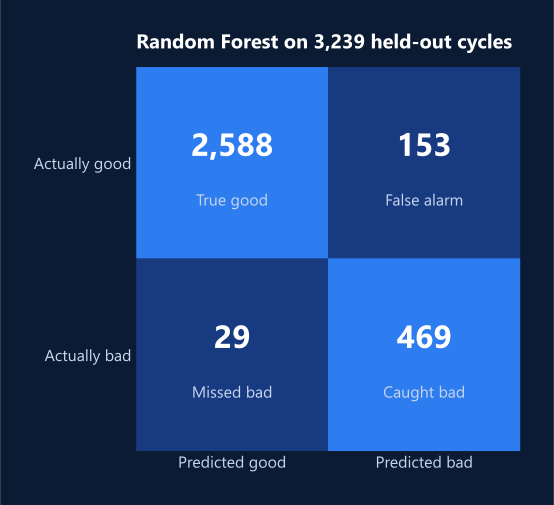
- Caught 469 of 498 bad cycles (94.2% recall) and missed 29.
- Raised 153 false alarms on good cycles, for 75.4% precision and an F1 score of 0.84.
- 0.988 AUC-ROC and 94.38% overall accuracy, against the roughly 85% that always predicting "good" would score.